Reading
The security lens
On this view, the 2030 warning ties household readiness to defence.
Geopolitics & money, explained calmly

Explainer · Everyday security
Britain asks households to keep three days of basics at home. Online, that has been tied to a defence warning.
Published Thursday 29 October 2026. Figures are the latest available on 29 October 2026.
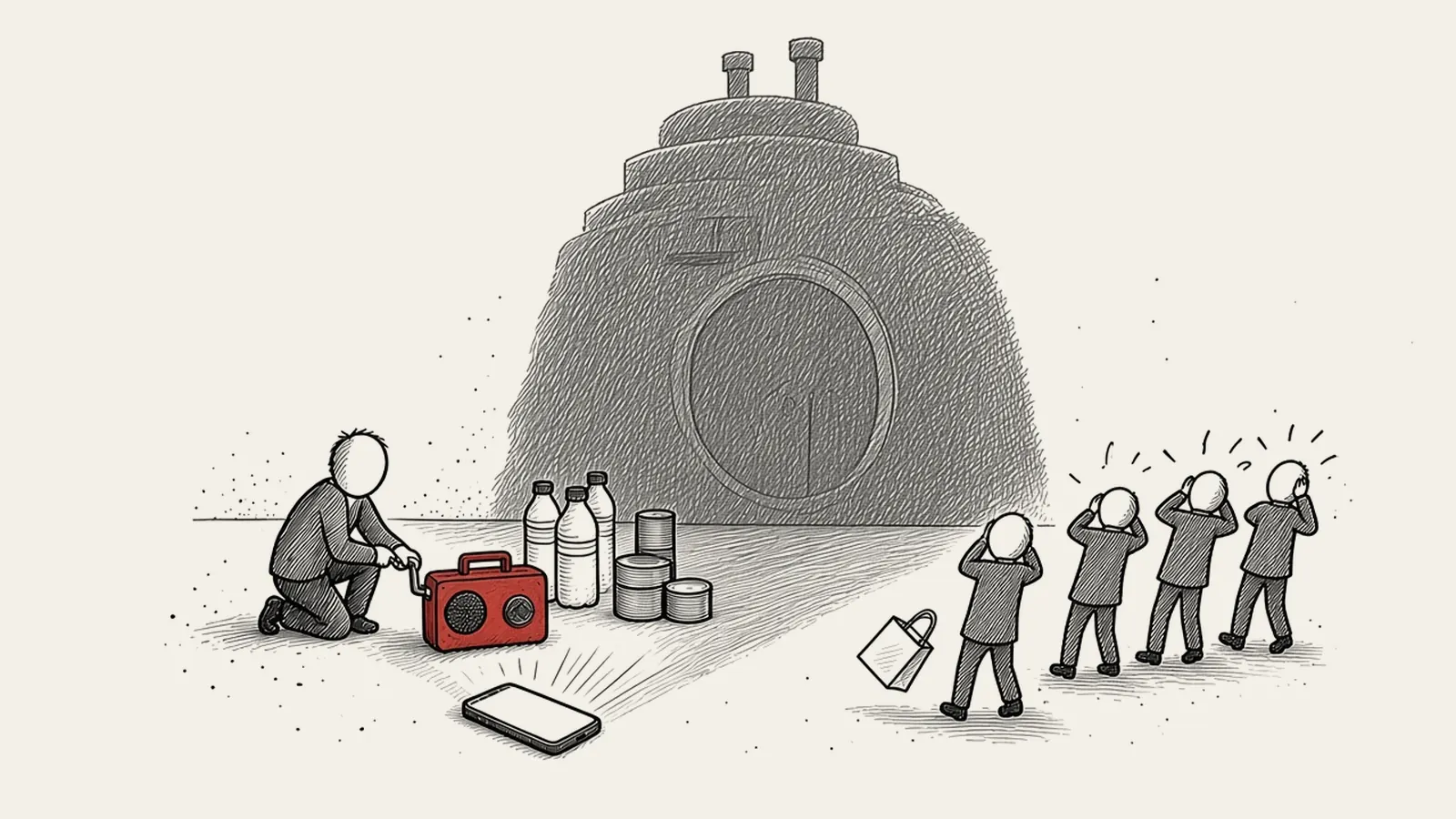
On 22 October 2026 the Cabinet Office, at the centre of UK government, launched Be Ready, “the first stage of a three-year campaign”, for severe weather and cyber attacks that can disrupt power, water, phones and the internet.
The checklist suggests three days’ supplies: 3 litres of drinking water per person per day; non-perishable food (it keeps without a fridge) needing no cooking; a torch, a battery or wind-up radio and a charged power bank (portable phone charger); cash in coins and notes; documents; first aid and medication.
It is voluntary, and much is not new: it rebrands a “Prepare” website running since May 2024. The government says it brings the UK into line with European peers; France, Ireland and the Netherlands use a three-day standard.
The release does not mention war, Russia or any specific threat. The prime minister, Andy Burnham, told BBC Radio 5 Live on 23 October: “It’s not about panicking... It’s about just taking sensible measures to have enough in the house to tide you over should there be a difficult situation.”
Sales surged: figures obtained by BBC Newsnight and published on 27 October show Iceland’s tinned-product sales up 40% over the weekend.
Some items did run out. The Guardian reported on 27 October that one brand of emergency wind-up radio sold out on Friday 23 October, and that the specialist shop EvaQ8 sold out of a wind-up radio and water purification tablets. On 26 October several brands of bottled water and soup were out of stock on Ocado (The Independent); Ocado told The Times its stock is “replenished daily”.
Several major supermarkets told the Guardian they saw no material change in demand for tinned goods, and the British Retail Consortium (UK retailers’ trade body) said “food availability remains strong”. Retailers are interested parties: specialist shops gain from publicity, while food retailers have reason to discourage panic buying.
Wes Streeting has been Defence Secretary since 20 July 2026. In a Telegraph op-ed (signed opinion article) on 24 October, he argued, as reported by Anadolu, that by 2030 Britain’s adversaries could have the forces and war economy to attack, leaving Britain and its allies a little over 1,000 days to be ready to fight and win. The Independent reported that he was “referencing the potential of Russian aggression”.
This separate defence message came two days later. The two overlapped: the BBC reports Streeting discussed household supplies on 22 October, and he told Newsnight: “It’s encouraging that people are taking practical steps to be ready.”
Robert Pape, a professor of political science at the University of Chicago and director of its Chicago Project on Security and Threats, wrote on 28 October in paid Substack (newsletter platform) posts and on X; he sells the newsletter and runs live briefings.
He calls Be Ready Britain’s biggest preparedness drive since the Cold War (we found no official source saying so) and argues Britain is in Russia’s sights. His X post merges it with the “1,000 days” warning and says shelves were emptied; the evidence above supports neither.
He also argues that a cross-border European revolt began on 17 October. Yet Madrid’s teachers’ strike began on 14 October and Albania’s protests on 30 May, and we found no evidence of coordination.
Ways of reading the story (viewpoints, not facts)
Reading
On this view, the 2030 warning ties household readiness to defence.
Reading
On this view, it is about storms and outages; self-reliant households free help for the most vulnerable.
Reading
On this view, what matters is who can afford to stock up.
Where they agree and differ
All three accept the advice is voluntary and modest; they differ on whether it signals danger.
Be Ready is about coping with outages, not about bills. Ofgem’s price cap for 1 October to 31 December 2026 is £1,723 a year for a typical household paying by Direct Debit, up 4% (£60) on July–September (Ofgem, 26 August 2026). About 35% of households are on fixed tariffs and are not affected.
The advice is to build up gradually, not buy everything at once; retailers said on 27 October that supplies are healthy. Food and non-alcoholic drink prices were 1.3% higher in September 2026 than a year earlier, against overall CPI inflation of 3.5% (ONS, 21 October 2026).
These mainly track interest rates, not this campaign. The Bank of England held Bank Rate at 3.75% on 17 September 2026; its next decision is due on 5 November. Moneyfacts put the average two-year fixed mortgage rate at 5.97% and the five-year at 5.99% on 28 October 2026.
The checklist includes some cash in coins and notes, alongside cards. The Bank of England’s average effective interest rate on individuals’ sight deposits (money that can be withdrawn without notice, including interest-bearing current accounts) was 1.66% in September 2026, barely changed from 1.65% in August.
Reflection Point
Be Ready asks households to cope for three days.
This is not financial advice.
Every fact is dated and linked; views are labelled as views. Read how we work. Spotted an error? Tell us at [email protected].